article

A Guide to Home Insulation Materials

By Fran J. Donegan via Realty Times

bluehammer

Insulation is one of those building products that you never see, because it is usually covered up by something else. But if you don't have enough, or if it is installed incorrectly, you're wasting energy and paying more for heating and cooling than is necessary.

There are a number of insulation products you can use to prevent energy loss. However, it is important to realize that insulation is only one part of a two-prong approach to energy efficiency. The other arm of the plan involves sealing all of the holes, cracks or openings caused by pipes, wires, chimneys or anything that creates an opening in a wall, ceiling, or most importantly, attic floor.

These openings allow interior air to escape to the unconditioned (not heated or cooled) space that surrounds your home. The sealing process is called "air sealing," and requires silicone caulk and expanding foam that comes in a can. It isn't exciting work, and while easy, it requires attention to detail. It is extremely important because the openings are escape routes for heated and cooled air and because many insulation products do not stop moving air. If you plan on insulating, be sure to attend to air sealing as well.

Where to Insulate

Basically, insulation should be placed in any area that separates your heated and cooled living spaces from areas that are not heated and cooled. These areas include:

  • Attics
  • Cathedral ceilings
  • Sidewalls
  • Walls between the living area and an attached garage
  • Floors over unheated basements
  • Floors over crawl spaces
  • Foundation walls

Insulation Materials

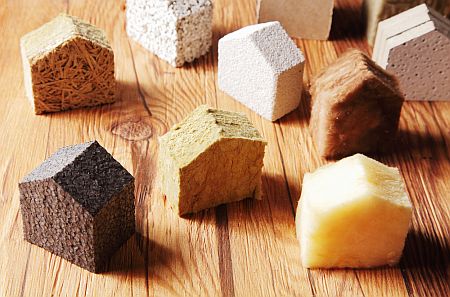
The effectiveness of insulation is measured by its R-value - "R" stands for resistance to heat flow. The higher the R-value, the better. It is important to match the insulation to the application as well. For example, fiberglass insulation has an R-value of about 2.8 to four per inch. Some foam panels have R-values of seven or eight. But you can easily find fiberglass batts or blankets that are 12 inches thick and designed for use as attic insulation, providing over an R-40. Standard foam panels only come in one-half to two inch thicknesses.
bluehammer

Some products are easier to install than others. Fiberglass batts simply roll into place. They are manufactured to fit snugly between ceiling joists and wall studs. When installing any insulation, it is important that the product be placed flat against the surface you are insulating. Any air space under the insulation or gaps around the edges will limit the effectiveness of the product.

Here's a look at some common insulation products:

Type of Insulation
R-Value per Inch
Where It’s Installed
Notes
Fiberglass

Mineral Wool

(Available in batts, blankets and as a loose fill material)
2.8 to 4
  • Attics
  • Open wall stud cavities
  • Floors over unheated spaces
  • Batts and blankets are DIY projects
  • Loose fill is a professional installation
  • Compressing the insulation or getting it wet reduces R-value
Cellulose 3 to 3.7
  • Attics
  • Open wall
  • cavities
  • Closed wall cavities
  • Hard-to-reach areas
  • Cellulose is ground- up paper treated with fire retardants
  • Blown-in with special equipment
  • Can be poured in place
  • Even distribution is necessary for effectiveness
Foam Boards
  • Polystyrene: 4 to 5
  • Polyisocyanurate / polyurethane: 6 to 8
  • Foundation walls
  • Interior basement walls
  • Floors
  • Ceilings
  • Interior applications must be covered with drywall for fire safety
  • Used for air sealing large openings
  • Some types are used under exterior siding to enhance the R value of the wall and prevent heat transfer through framing members
Spray-On Polyurethane
  • Open-cell: 3.6 to 4.3
  • Closed-cell: 5.6 to 6.8
  • Open and enclosed wall cavities
  • Between rafters on cathedral ceilings
  • Hard to reach areas
  • Irregularly shaped areas
  • Requires special application equipment
  • Closed-cell material is denser and acts as a vapor barrier
  • Both act as an air barrier

Use this chart as a reference point when insulating your home. Proper insulation will help lower your energy bills and keep your home at a comfortable temperature.

Want to estimate your home improvement costs before talking with a contractor? Claim your home for free with bluehammer to estimate costs, secure your home inventory and learn more about your home.

* THIS REPORT IS AN OPINION THAT MAY BE INACCURATE AND IS PROVIDED SOLELY AS AN INFORMATIONAL TOOL NOT DESIGNED TO PROVIDE DEFINITIVE ANSWERS. ALL ELEMENTS ARE OFFERED "AS IS" AND BLUEBOOK EXPRESSLY DISCLAIM ANY AND ALL WARRANTIES, REPRESENTATIONS, AND GUARANTEES OF ANY NATURE, EXPRESS, IMPLIED OR OTHERWISE, INCLUDING BUT NOT LIMITED TO ANY IMPLIED WARRANTIES OF MERCHANTABLITILY, NONINFRINGEMENT, TITLE, QUIET ENJOYMENT, ACCURACY, OR FITNESS FOR A PARTICULAR PURPOSE. IN NO EVENT SHALL BLUEBOOK (OR THEIR SUPPLIERS) BE LIABLE FOR ANY GENERAL, DIRECT, SPECIAL, INCIDENTAL, INDIRECT OR CONSEQUENTIAL DAMAGES OF ANY KIND, OR ANY DAMAGES WHATSOEVER (INCLUDING WITHOUT LIMITATION, THOSE RESULTING FROM USE OF THE PRODUCT, INCLUDING : (1) RELIANCE ON THE MATERIALS PRESENTED, (2) COSTS OF REPLACEMENT GOODS, (3) LOSS OF USE, DATA OR PROFITS, (4) DELAYS OR BUSINESS INTERRUPTIONS, (5) AND ANY THEORY OF LIABILITY, ARISING OUT OF OR IN CONNECTION WITH THE USE OR PERFORMANCE OF INFORMATION) WHETHER OR NOT BLUEBOOK HAS BEEN ADVISED OF THE POSSIBILITY OF SUCH DAMAGES.

Know what you should pay for your home improvement projects with bluehammer.Claim your home. It's free!

Popular


Nontraditional Places to Use Pendant Lights

When you picture pendant lights, where do you see them in a house? Close your eyes and imagine it.

8 Great Tricks For Keeping Mosquitos Away

We all know about using bug spray. And citronella candles. But what about other ways to keep those pesky mosquitos away? As if they weren't annoying enough before, the threat of the Zika Virus has made mosquitos even more dangerous. So we've scoured the web for the best tricks for keeping the buggers away.

You Really Should Inventory Your Personal Property

A home inventory is a smart way to safeguard your valuables, saving money and time.

Chimney Liners: Does Your Home Have One - Do You Even Need One?

You rely on your chimney being safe. Whether you use your fireplace for wood-burning fires, you have a furnace that vents through your chimney, you utilize a wood stove or gas insert, your chimney needs to be able to handle heat and sparks without allowing damage to your home. Stone or brick chimneys can be made safer with a flue lining that helps to move heat and gases up and out of your home.

Do's And Don'ts For Painting Your Bathroom Cabinets

If your bathroom cabinets are old, ugly, tired, or all of the above, you've probably thought about painting them more than a few times. And if you're like us, you may have done a bit of research but failed to take it further for fear that they won't end up looking decent. But the truth is that if you follow the directions of those who've been there before (and, especially, if you heed their warnings regarding shortcuts and mistakes), you can transform your bathroom pretty easily. This list of do's and don'ts will help guide you.

Creative Ways To Keep Your Home Cool Without Running Your Air Conditioning 24-7

Heat wave! Are you feeling it? Are you over it? Are you dreading this month's electric bill that will rival your monthly grocery budget? There are a few tricks that can help you keep cool at home without running your air conditioning all day.

Home Repairs VS Improvements: No Clear Answer

Question: I am having trouble figuring out what constitutes an improvement and what is ordinary maintenance. Thinking ahead to selling my house in a few years when the market rebounds, I have been keeping accurate records so that I can deduct these costs to lower the capital gains. Recently, I remodeled a bathroom, replaced a deck, replaced and upgraded the spa filter and motor, replaced the front door with a fiberglass model guaranteed to last more than my lifetime, and replaced a roof and rain gutters. Which of these can I safely regard as improvements, and which are just maintenance?

Remodeling Your Outdoor Patio On A Budget

Creating and sticking to a home improvement project's budget is about as easy and comfortable as pulling teeth. But when it comes to a task as exciting as an outdoor space remodel, it's necessary to think and talk about the budget before taking any further steps.

It's A Great Time for Decluttering Your Home

It's always great to take some time from your busy schedule to declutter your home. While it may not always be enjoyable, here are some useful tips that can make decluttering easy and well worth it.

Home Foundations And Why Material Matters

The typical single-family home can weigh anywhere from 80,000 to 160,000 pounds. Foundations provide a solid base for a home's weight, help to ensure the house stays level and provides a base for construction to take place. Foundations matter, and so does the material that they're made of. Here's a closer look at both, starting with materials and why they matter.

See More Articles